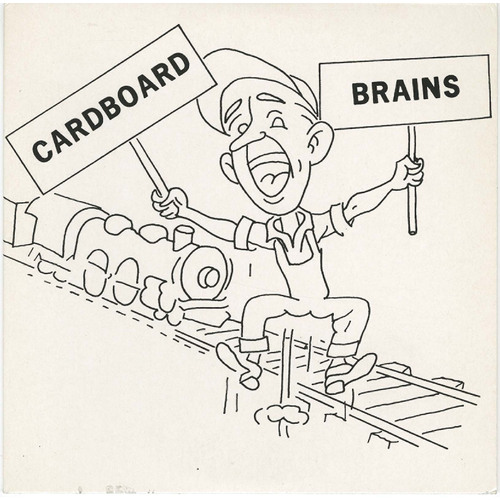
Insight
Formed in Toronto in 1977, Cardboard Brains were part of the first wave that helped define the Queen Street circuit as punk, new wave, and art-damaged experimentation collided in clubs like The Edge and the Horseshoe Tavern. Built around the writing and restless creative drive of John Paul Young and guitarist Vincent Carlucci, the band moved quickly from raw, primitive blasts into stranger shapes—quirky lyrical angles, jagged arrangements, and early synth colour that marked them as slightly out of step with the more uniformly aggressive posture of many contemporaries. Even the name carried a wink: before settling on Cardboard Brains, the group cycled through candidates including Media Accident, Deadly Alien Foam, and Psychiatric Prison.
Their recorded debut arrived the same year with a four-song 7-inch EP bearing the legend “Cardboard Brains 1977,” later nicknamed The White EP. It captured the band in full early-strike mode—originals like ‘I Want To Be A Yank’ and ‘Can Stress Kill?’ alongside their take on Boyce & Hart’s ‘Stepping Stone’—and it quickly tied them to the emerging Toronto network as they worked constantly and shared bills with scene staples. Onstage, they also stood out visually and theatrically. Young often treated performance as a form of character work, favoring costumes over the standard ripped-jeans uniform, and occasionally pushing the presentation into outright performance-art territory—an approach that dovetailed with his training as a thespian and reinforced the sense that Cardboard Brains were “danceable but weird,” as one observer memorably put it.
In December 1978, Cardboard Brains appeared at The Last Pogo, the two-day Horseshoe event that became a defining marker of the era, with portions of the shows preserved on film and record. That documentation widened the band’s footprint and also revealed their more adventurous instincts in a live setting. The following year they issued a four-song 12-inch follow-up commonly known as The Black EP, by then edging further into a sharper, more structured hybrid—still punk at the core, but increasingly informed by art-rock ambition and an expanding palette of keyboards and electronics. Through these years the rhythm section shifted repeatedly, while Young and Carlucci remained the creative constants at the center of the project.
By 1980, Young was drawn toward a more controlled format for making music and stepped into a solo, self-contained approach with The Life of Ermie Scub, performing the instrumentation himself and leaning decisively into colder, minimal electronic language and conceptual writing. The project’s impact was recognized with a CASBY Award, and it also clarified the larger arc: Cardboard Brains had begun as a punk unit, but the story was always pushing toward synthesis, structure, and a kind of prog-minded tension that didn’t fit neatly inside any single scene category.
Cardboard Brains reunited for The Edge’s brief resurrection and anniversary celebration on April 26, 1981, reconnecting with the CFNY ecosystem that had supported and amplified so much Toronto new wave activity. Recordings from that night were issued as Live at The Edge in a very limited numbered and autographed edition, effectively serving as both a snapshot of a late-period lineup and a bridge between earlier vinyl statements and the direction the material was still trying to travel. After that, the band splintered into other paths: Gregory went on to Woods Are Full of Cuckoos and the Lawn; Carlucci later formed Station Twang with Carl Tafel; and Young’s parallel career as an actor and composer expanded into Canadian television and film work.
The Cardboard Brains catalogue has had a long afterlife in collector culture and in the way Toronto punk history keeps resurfacing for new listeners. Their ‘Stepping Stone’ appeared on Killed By Death Vol. 26 in the mid-1990s, raising their profile outside the local story, and in 1998 their work was consolidated on the John Paul Young And Cardboard Brains compilation CD, which helped trigger occasional revivals of the name for select Toronto dates. In the 2000s the band’s influence even reappeared as a direct homage through Nardwuar the Human Serviette and his group The Evaporators, who recorded a song titled ‘Cardboard Brains’ and circulated liner-note history that reframed the original band for a different generation.
-Robert Williston
John Paul Young: vocals, keyboards
Vincent Carlucci: guitar, vocals
Richard Miller: drums
Paul O'Connell: bass
Songwriting
All compositions written by Young / Carlucci
Production
Produced by Tibor Takacs
Executive producer and publisher: John Gundy
Artwork
Label design by Patricia Meade
LYRIC SHEET
I WANT TO BE A YANK
Who really cares about Maggie T.?
I’m really sick of the C.B.C.
The kids are rotting at U. of T.
Just to work for the U.I.C.
Rene Levesque’s the missing link.
Your money’s all down the drink.
C.B.C. T.V. programs really stink.
I wish I didn’t have to think.
U.S. Dey got tainted ham.
U.S. Dey got Son of Sam.
U.S. Dey got Sirhan Sirhan.
U.S. Dey got Viet Nam.
U.S. Dey got Jimmy Carter.
U.S. You can be a martyr.
U.S. Dey got World Series.
U.S. I can live on T.V.
I WANT TO BE A YANK.
STEPPIN’ STONE
(T. Boyce/B. Hart)
CAN STRESS KILL?
Sometimes I feel,
Feel like a robot.
Standing here it’s boring,
Monohectic ya.
I think about things,
Things that make me happy,
Maybe like what,
What I do on the weekend.
Oh tell me if you will,
Can Stress Kill?
I’m a modern man.
I live in the city.
I don’t like noise,
The crush of a car,
The crash of a crowd,
The bark of the dog
Children laughing in my ear.
Oh tell me if you will,
Can Stress Kill?
Who are my friends?
I can’t tell that now.
I’m really crazy.
I walk down the street.
I don’t like guns,
Without humour.
It can really be difficult.
Oh, tell me if you will,
Can Stress Kill?
Gallery
Images
6 images
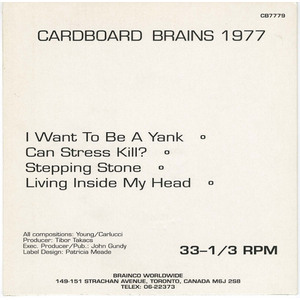
45-Cardboard Brains-The White EP BACK
45-Cardboard Brains-The White EP INSERT SIDE 01
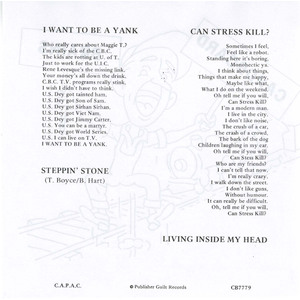
45-Cardboard Brains-The White EP INSERT SIDE 02
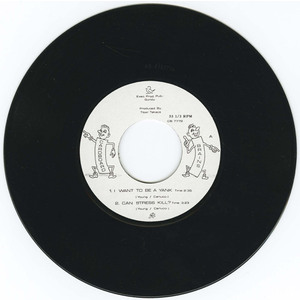
45-Cardboard Brains-The White EP VINYL 01
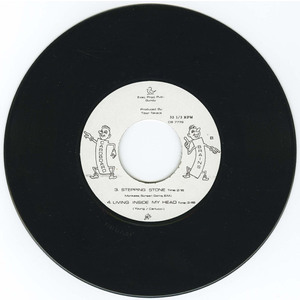
45-Cardboard Brains-The White EP VINYL 02

The White EP
Media
Videos
0 videos
No videos available for this title.
Credits
In Transit
No Comments